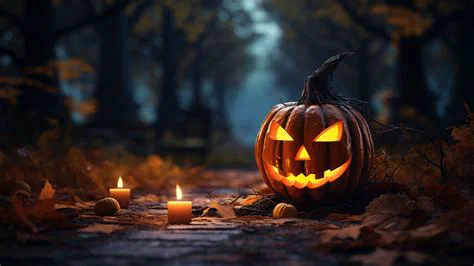
Spookiness, sugar, and six-year-olds in costumes.
These are the elements that our culture has associated with Halloween.
This holiday has been a source of controversy and confusion for many households. Some people are against the holiday and see it as a devil-worshiping day (which is how I was raised). Others see it as a reason for candy, costumes, and decorations, and others may not know what to do with it.
In this blog I will discuss not only the origins of Halloween, but also how we should view it as Christians.
The Origins
While we don’t know the everything about the origins of Halloween, there are two traditions that most likely started it all.
Samhain 1
Samhain is an ancient Celtic Irish holiday that was celebrated about 2,000 years ago, but many elements of the holiday still carry over into modern Halloween.
Samhain was the day that represented the shift from summer to winter, which was celebrated from the night of October 31st to November 1st. During this time, everything was brought indoors for the winter: livestock, crops, and essentially everything else people didn’t want getting left out in the cold.
The night of Samhain was believed to be a very spiritual night. Souls, ghosts, fairies, and other beings would wander throughout the night, and masks/disguises were worn by the living to hide from them. Carved out turnips would be used as lanterns to scare away the spirits as well.
The practice of divination (the acquiring of knowledge, sometimes of the future, through spiritual means) was extremely emphasized on this night, as the wakened spirits are more active than ever.
So just a recap - we have costumes, carved out lantern plants, and a spooky, spiritual atmosphere.
Sound familiar yet?
Surprisingly, another tradition has contributed to modern-day Halloween on the opposite side of the spectrum.
All Hallows Eve 2 and All Saints’ Day 3
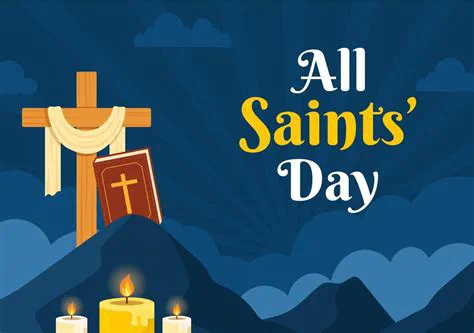
All Saints’ Day is a Catholic tradition that originally commemorated the saints that have passed on into heaven, and later the tradition commemorated those that had been martyred (being killed for one’s faith) as well.
Because this tradition is over a thousand years old, it has been celebrated on different days of the year in many different places. The earliest account of All Saints’ Day being celebrated on November 1st was the 8th century AD by Pope Gregory III. Pope Gregory the IV officially made November 1st the date of All Saints’ Day.
All Saints’ Day was also known as All Hallows Day, and the day before was known as All Hallows Eve. This is where we get the modern name for Halloween.
On All Hallows Eve, Catholics would attend a Mass service, where they would pray and fast in preparation for the next day’s celebration. After the Mass, they would leave to the graveyard and place candles and gifts for the All Saints’ Day celebration.
Fun fact: these candles would be placed inside gourds with holes in them, which is where we get modern-day jack-o-lanterns.
The reasoning for this date was most likely to overshadow the pagan of Samhain, which was celebrated the night of October 31st into November 1st.
Trick-or-Treating 2
Trick-or-Treating comes from the traditions of the day after All Saints’ Day, which is known as All Souls’ Day.
The tradition goes back to England where children would go from house to house and beg for food in exchange for prayers for people’s deceased loved ones.
The Church gave out bread called soul cakes. This was meant to replace the tradition of pagans leaving out food and wine for active spirits.
What Are the Different Views and Which Should We Hold?
Now that we know the origins of Halloween, the question is should we participate in it?
I know this is a very polarizing question, so I will try to present the following observations as unbiased as possible.
“Halloween is Satanic” View
As established before, yes, Halloween has deep roots within pagan, demonic tradition. So when someone tells you that Halloween is a “devil-worshiping” holiday, there is some truth to that statement.
Remember that this holiday was not just about people being afraid of the spirits wandering the night - they were attempting to contact them through sinful means.
“There shall not be found among you anyone… who practices witchcraft, or a soothsayer, or one who interprets omens, or a sorcerer, or one who conjures spells, or a medium, or a spiritist, or one who calls up the dead. For all who do these things are an abomination to the LORD, and because of these abominations the LORD your God drives them out from before you.”
— Deuteronomy 18:10-12 NKJV
The Bible makes it clear that God has no tolerance for those who meddle with the spiritual world through their own means. Ever.
The only spiritual relations you should be having with is God.
We know that Halloween is attached to an extremely sinful past, and participating in them can be seen as a form of endorsement. Why would we as Christians ever want to be even close to associated with something that corrupt?
This part of the argument is partially agreed upon for most Christians. Obviously God does not want us indulging in demonic practices, so we must be careful. However, the cultural view will say that we are nowhere near the old, demonic traditions.
Cultural View
Halloween is a time for candy, costumes, and a night of fun!
We know that God is not striking us down because kids are dressing up as princesses, and robots to go around and have some candy. The whole “Satanic holiday” dispute is pretty short-sided.
Decorating the house? Nothing wrong with that. Dressing up? Nothing wrong with that. Getting candy? Nothing wrong with that.
Everything about modern-day Halloween is the farthest thing from Satanic.
What Christians Should Be Doing
Now that we’ve taken a look at the historical context of Halloween and observed the two sides of the debate, let’s try and understand what we should be doing as Christians.
Let’s get one thing straight: the cultural view is correct that dressing up and getting candy is not sinful. If we are honest with ourselves, we know that this specific aspect of Halloween is not the problem, so let’s put that to the side.
The real underlying issue is what we are associating ourselves with.
If we are associating ourselves with death-related symbols, popularized demonic elements, and other things glorifying fear and death, we must ask ourselves how much of Jesus is being seen.
A lot of Halloween is fun and candy, yes, but also a lot of it is used as a platform for popularized and “culture-ified” evil.
So where am I going with this?
On a practical level, there should be nothing wrong with participating in Halloween.
However, anything that can be seen as demonic/Satanic should be something we try to avoid. We don’t want to send people the wrong message about what our beliefs are.
For example, (a silly example I might add), you’d find it pretty strange to see a cow holding up a sign promoting the nearest steakhouse, or a pig holding up a sign promoting the nearest hot dog stand.
People naturally represent and associate themselves with the things they support and/or love, so make sure you are showing other people that your ultimate love is found in Christ, not the world.
I recognize that this has been a heated debate for many years, so this is what I will say:
We know the history. We know the facts. These are not things being debated.
The debate lies within the convictions of millions of Christians.
I don’t know your beliefs or how you were raised, but I know for certain that there are many household that hold a strong conviction about the celebration of Halloween. Halloween’s demonic origins that have been carried into modern Satanism is a plague on the day of October 31st - a day that the Lord has made.
The Bible does not say anything specifically about Halloween, but we know that when our fellow brothers and sisters in Christ have a conviction about something (in this context its about unclean food eaten by the pagan Gentiles) Paul says this:
“I know and am convinced by the Lord Jesus that there is nothing unclean of itself; but to him who considers anything to be unclean, to him it is unclean. Yet if your brother is grieved because of your food, you are no longer walking in love. Do not destroy with your food the one for whom Christ died.”
— Romans 14:14-15 NKJV
Here Paul is telling the Romans that while the food they eat is simply just food and not “unclean,” they should not eat it if it causes a fellow brother to stumble.
Halloween is a very similar issue.
Many Christians see it as an “unclean” day. Whether that is true or not is beside the point. Whatever view you hold, you should think about how you are presenting yourself to those that are unbelievers and believers alike.
When we love others more than our desires for candy and costumes, it makes debates like this a lot less of an issue.
So maybe you have a conviction about Halloween, or maybe you don’t. Whatever it is, just remember to put the Lord and your brothers and sisters in Christ at the forefront of your actions and desires.
Citations
Preston, Charles. “Samhain.” Encyclopedia Britannica, August 28, 2026, britannica.com/topic/Samhain. ↩︎
Woodrell, Lauren. “All Hallows Eve: History, Traditions, and Observations.” Magis Center, October 17, 2024, magiscenter.com/blog/all-hallows-eve-history-traditions-and-observations. ↩︎ ↩︎
“All Saints’ Day.” Encyclopedia Britannica, October 31, 2025, britannica.com/topic/All-Saints-Day ↩︎